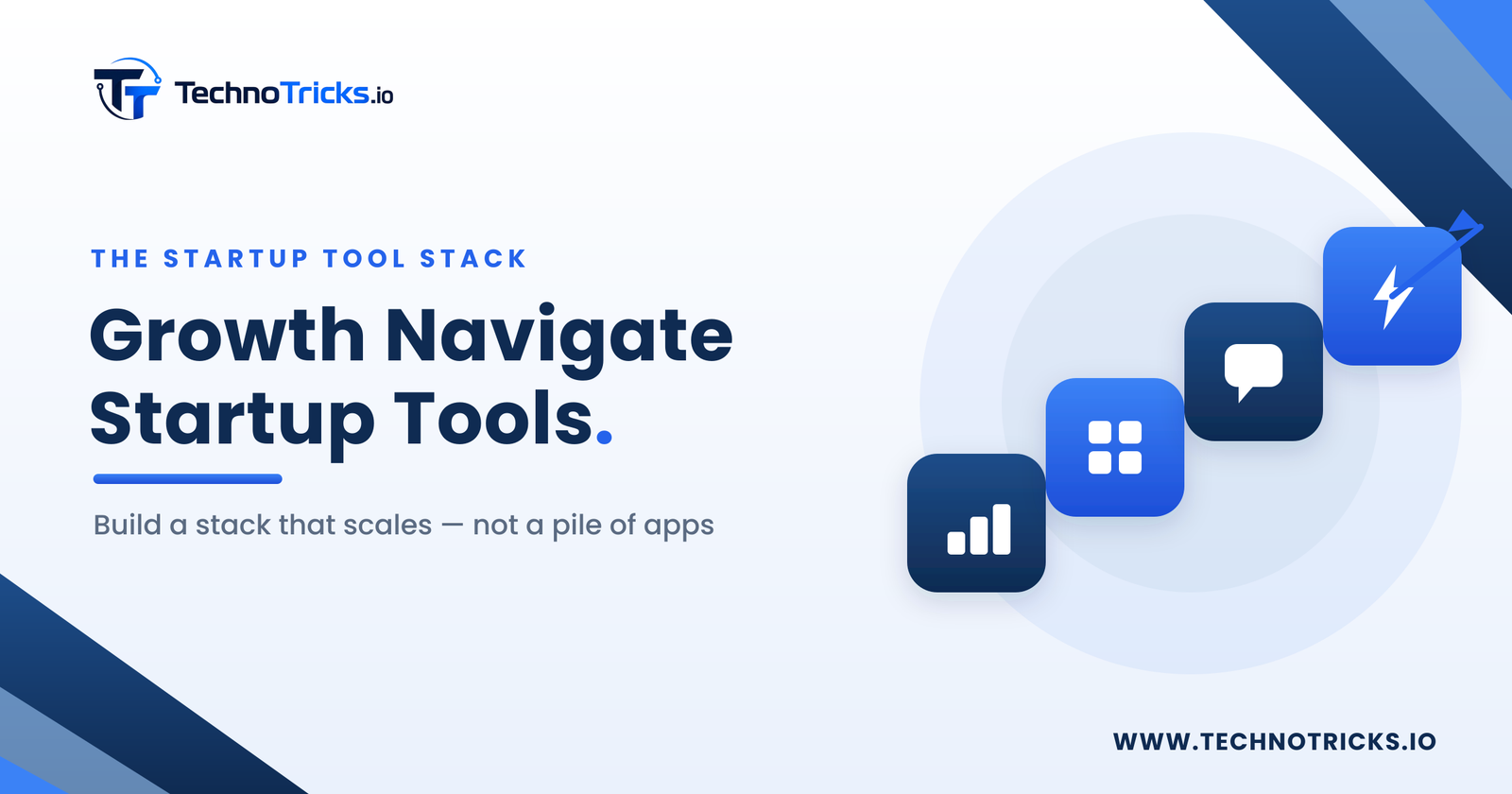
Growth Navigate Startup Tools: How to Build a Stack That Scales Without Draining Your Budget
Key Takeaways
- Growth Navigate Startup Tools are the software platforms early-stage companies use to acquire customers, sell, collaborate, measure, automate, and manage money — with less manual work and better decisions.
- The goal isn’t more apps — it’s a connected stack. A crowded tool pile creates cost, confusion, and slower teams, not growth.
- Match the tool to a real problem and your current stage. Add tools in step with growth, not because they’re trending.
- Six categories cover most needs: analytics, CRM/sales, communication, project management, automation, and finance.
- Tools are amplifiers, not answers. Great software in an undisciplined team produces nothing.
Most startups don’t fail for lack of ideas. They fail because they can’t execute — or because they drown in a dozen disconnected subscriptions that never move a single metric. This guide fixes that, showing you which tools matter, when to add them, and how to avoid the quiet budget leaks.
Quick Answer
Growth Navigate Startup Tools are software platforms that help early-stage companies grow faster and make data-driven decisions across six core jobs: analytics, sales and CRM, team communication, project management, automation, and accounting. The smart approach isn’t collecting apps — it’s assembling a connected, affordable stack that fits your stage. Start with one analytics tool and one execution tool, connect them (often through Zapier), measure whether each earns its cost, and keep only what moves a real number.
What are Growth Navigate Startup Tools, exactly?
In plain words, these are the digital systems that run the everyday work of a startup — the platforms that let you move faster, measure accurately, and automate the boring stuff.
The category is broad on purpose. It spans finding customers, tracking leads, keeping your team aligned, understanding user behavior, handling repetitive tasks, and watching your runway. Some people use “growth navigate” to describe tools that map a path to expansion — sourcing investors, spotting ideal customers, forming partnerships. Others use it for the full operational stack. Both readings are correct, and that’s exactly why the term feels slippery when you first search it.
Here’s the reframe that helps: don’t think of these as apps. Think of them as jobs to be done. Every startup, regardless of industry, needs to answer a handful of the same questions. The tools are just how you answer them.
Why do startups need a tool stack — not just more apps?
Here’s what nobody tells you when you’re excited and downloading your fifth free trial of the week: more tools rarely mean more growth. Often it means the opposite.
Too many disconnected apps create real damage. Data gets scattered across platforms that don’t talk to each other. Costs creep up quietly through subscriptions nobody remembers approving. Teams waste time copying information between systems. What was supposed to solve problems starts manufacturing new ones.
A startup with resource constraints — limited budget, small team, no spare hours — cannot afford that drag. Larger companies survive bloated software; a five-person team does not. The winners aren’t the founders with the most apps. They’re the ones who match the right tool to a real problem, add tools in step with their stage, keep everything connected, and cut what they no longer need.
Think of your stack like packing for a long trek. Every item you carry has a cost measured in energy. The experienced hiker doesn’t bring the most gear — they bring the right gear, and they know when to leave something behind.
The six categories every startup stack should cover
You don’t need every category on day one. But over time, most growing startups end up filling these six roles. Here’s what each does and a few widely used tools per job.
Analytics and measurement
You cannot grow what you cannot measure — and this is the category most startups get wrong first, either by not tracking at all or by hoarding data they never act on. Look for event-based tracking (not just pageviews), funnel visualization, and cohort retention analysis. Google Analytics 4 covers the basics for free. For deeper product analytics, Mixpanel and Amplitude remain the standard, both with generous free tiers, while PostHog has emerged as a strong open-source, self-hostable alternative favored by technical teams.
Sales and CRM
Once leads start arriving, spreadsheets stop scaling. A CRM keeps every contact, deal, and follow-up in one place so nothing slips. HubSpot is popular because it bundles sales, marketing, and CRM with a free tier that grows with you. For B2B teams planning to scale, Salesforce offers depth, though it asks for more setup.
Communication and collaboration
Long email threads are where momentum goes to die. Slack keeps conversations organized by team and project, cutting internal email dramatically. It’s often the first non-analytics tool a startup adopts, and for good reason — alignment is a growth lever.
Project and knowledge management
As the team grows, “where’s that document?” becomes a daily tax. Notion works as a company brain — docs, notes, wikis, and lightweight project tracking in one connected space, with a free plan that suits early teams.
Automation
The manual grunt work — copying data, sending routine updates, syncing tools — quietly eats hours. Zapier connects your apps so information flows automatically, and it’s the glue that turns separate tools into an actual stack.
Finance and runway
Money is the ultimate metric, and running out of it is the ultimate failure mode. Tools like Puzzle help with financial planning and watching your runway, so cash surprises don’t blindside you.
Best Growth Navigate Startup Tools at a glance
Here’s a quick comparison to orient you. Pricing shifts constantly, so treat “free plan available” as the stable fact and verify current tiers before you commit.
| Tool | Best for | Category | Free plan? |
|---|---|---|---|
| Google Analytics 4 | Understanding user behavior | Analytics | Yes |
| Mixpanel / Amplitude | Deep product analytics | Analytics | Yes — free tier |
| HubSpot | Sales + marketing alignment | CRM | Yes |
| Salesforce | B2B scalability | CRM | No — trial |
| Slack | Team communication | Collaboration | Yes |
| Notion | Docs and organization | Project mgmt | Yes |
| Zapier | Automating manual work | Automation | Yes — limited |
| Puzzle | Financial planning, runway | Finance | Varies |
Methodology: these are tools consistently recommended across multiple 2026 startup-stack guides, chosen for wide adoption, accessible free tiers, and clear fit to a single core job rather than feature overlap.
How do you choose the right tools for your stage?
The right tool depends on where your startup actually gets stuck — not on which platform has the flashiest feature list. Work through it in order:
- Name the real problem. Are you losing leads, flying blind on data, or drowning in manual tasks? Start there, not with a tool.
- Match to your stage. Pre-seed and seed teams need cheap, simple, fast. Growth-stage teams need measurement and repeatable process. Scale-stage teams (50+ people) need depth, integration, and compliance.
- Start with two layers. Most founders pair one data or research tool with one execution tool. Resist adding more until those earn their keep.
- Connect everything. Use Zapier or native integrations so data flows automatically and you stop copying between apps.
- Measure and prune. Every 90 days, ask whether each tool saved time or moved a number that matters. Keep what works. Cut what doesn’t.
That loop — simple, connected, measurable, scalable — is the entire philosophy in four words.
The mistake that quietly drains your budget
Here’s the contrarian truth most listicles won’t print: the tool is almost never the thing holding you back.
The most important thing to understand about Growth Navigate Startup Tools is that they are amplifiers, not answers. A world-class analytics platform in the hands of a team with no analytical culture produces nothing. Meanwhile, a basic email tool wielded by a team with sharp positioning and a deep understanding of its customer can produce extraordinary results.
So before you reach for a new subscription, ask three questions. What strategy is this meant to serve? What outcome do I expect in 90 days? Who will own the discipline of using it well? If you can’t draw a straight line from a tool to a metric you’re trying to move, that’s your warning sign — not a reason to buy.
Frequently asked questions
What are Growth Navigate Startup Tools?
They’re software platforms early-stage companies use to grow and scale, covering analytics, CRM and sales, communication, project management, automation, and accounting — with less manual work and better decisions.
Which tools should a new startup start with?
Begin with one analytics tool (like Google Analytics 4) and one execution tool that solves your biggest bottleneck — often a CRM like HubSpot or a collaboration tool like Slack. Add more only as real problems appear.
Are these tools free?
Many offer generous free plans that suit early startups, including HubSpot, Notion, Slack, and Google Analytics 4. Paid tiers unlock more as you grow, so verify current pricing before committing.
How many tools does a startup actually need?
Fewer than you think. A crowded, disconnected stack causes cost and confusion. Aim for a small, connected set where each tool owns one clear job.
Do more tools mean faster growth?
No. Discipline beats quantity. Founders who match the right tool to a real problem and cut what they don’t use outperform those chasing every trending app.
The bottom line
Growth Navigate Startup Tools give small teams the power to compete with much bigger ones — but only when chosen with discipline. The stack isn’t a trophy shelf; it’s a system. Build it stage by stage, keep it connected, measure ruthlessly, and delete without guilt.
The best operators I’ve seen can explain, in one sentence, why they pay for every tool they own. Can you? Look at your current stack right now — which subscription would you struggle to justify in growth terms? That’s usually the first thing worth cutting.
Not sure which tools fit your stage? You can book a free 30-minute consultation with an engineer and walk away with a written action plan — no sales script.